Appearance
Part I — Foundations
3. The Octagon as Validation Instrument
Learning Objectives
- Apply the eight-question architecture audit to any zero-trust deployment
- Score an architecture against each axiom using the green/yellow/red rubric
- Identify which axioms are universally violated across common deployment archetypes
- Explain why Hard Deny violates Byzantine Fault Tolerance and why that pattern causes business damage
Prerequisites: Chapter 2 (The Octagon)
From Theory to Audit
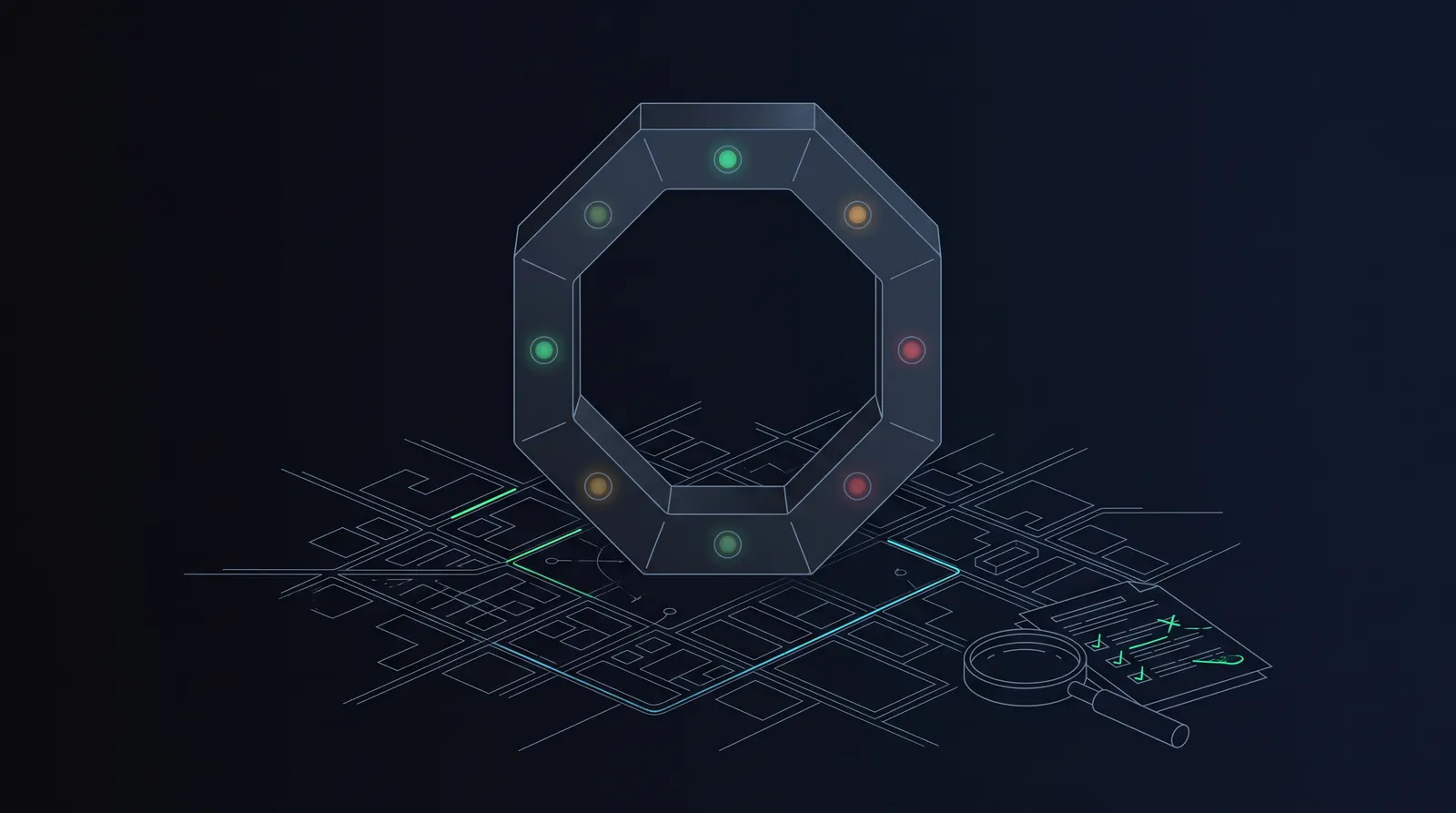
The Octagon is a theoretical framework. But its greatest practical value is as a diagnostic instrument — an eight-question probe that takes under an hour to apply and produces a clear picture of where any zero-trust deployment deviates from the axioms.
This chapter transforms each axiom into an audit question, provides a scoring rubric, and walks through the results of applying the instrument to all four archetypes (A through D). The goal is not to produce a numeric score — zero-trust is not a maturity scale — but to identify which axioms are violated and what the consequences of those violations are.
The Eight-Question Architecture Audit
Present these questions to the architecture owner, the CISO, or the lead engineer responsible for the deployment. "I don't know" is a valid answer — and a red flag.
Question 1 — No Intrinsic Trust → §2: Axiom 1 — No Intrinsic Trust
Does any entity in your system receive trust by virtue of its position, ownership, or history?
Probe deeper: "If a workload runs on the corporate Kubernetes cluster, does it automatically get access to internal services?" "If a user is on the VPN, are they trusted more than a user who is not?" "If a service account was created three years ago and has never been used maliciously, does anyone periodically re-verify whether it still needs its permissions?"
Scoring:
- 🟢 Green: No. Every access decision is independent. Network position, historical behavior, and identity age are not trust factors. All access is explicitly authorized per-request.
- 🟡 Yellow: Mostly. Some legacy systems grant access by subnet or VPN membership, but critical paths use per-request authorization. Acknowledged technical debt.
- 🔴 Red: Yes. Internal network is a trust zone. Service accounts have standing access. VPN users are "inside."
Question 2 — Verifiable Policy → §2: Axiom 2 — Explicit, Verifiable Policy
Can a neutral third party replay your access policy with a stored input set and reproduce the same verdict?
Probe deeper: "If an auditor asks to verify why a specific request was denied last Tuesday, can you demonstrate — mathematically, not with a screenshot of a dashboard — that the policy produced that denial?" "Is your policy engine's rule set a deterministic function?" "Can you independently execute the policy outside the vendor's SaaS console?"
Scoring:
- 🟢 Green: Yes. Policy is stored in version control, is a deterministic state machine, and can be replayed by an independent evaluator producing identical verdicts.
- 🟡 Yellow: Partially. Policy rules are documented and auditable, but the evaluation engine is a vendor black box. Replay requires vendor cooperation.
- 🔴 Red: No. Policy is configured through a vendor UI with no exportable, replayable form. "Trust the dashboard."
Question 3 — Unbypassable Mediation → §2: Axiom 3 — Unbypassable Mediation
Is there any path — physical, logical, or administrative — to a resource that does not invoke the evaluation function?
Probe deeper: "If someone plugs a crash cart into the server, can they access data directly?" "Once a pod is inside the Kubernetes cluster, can it reach other pods without a policy check?" "Do your SaaS platforms enforce the same access policy as your self-hosted applications?" "Do administrators have a backdoor that bypasses the PDP?"
Scoring:
- 🟢 Green: No. Every interaction, including emergency administrative access, physical console access, and SaaS-to-SaaS communication, is mediated by the evaluation function.
- 🟡 Yellow: Mostly. Self-hosted resources are fully mediated; some SaaS platforms or legacy systems have independent access paths. Emergency break-glass exists but is audited.
- 🔴 Red: Yes. Once past the network perimeter, internal traffic is unmediated. SaaS platforms authenticate independently. Administrators have unmediated console access.
Question 4 — Continuous Verification → §2: Axiom 4 — Continuous Verification
What is the maximum time between the moment a verdict is rendered and the moment the action it authorizes completes?
Probe deeper: "A user authenticates with MFA at 9:00 AM. At 4:30 PM, their laptop is compromised by malware that uses their valid session cookie. Does the system re-verify anything between 9:00 and 4:30?" "A container image is scanned in CI/CD. It deploys and runs for six months. Is it re-scanned at runtime?" "What is the fastest possible compromise-to-exploitation timeline in your threat model, and is your re-verification interval shorter than that?"
Scoring:
- 🟢 Green: Re-verification is continuous or at a cadence shorter than the compromise-to-exploitation window. Behavioral signals, hardware attestation, and cryptographic re-challenge combine to shrink the window to seconds or less.
- 🟡 Yellow: Re-verification occurs periodically (minutes). Faster than standard session lifetimes but not risk-calibrated against specific adversary timelines.
- 🔴 Red: Verification occurs once at authentication or deployment. Session token is trusted for its entire TTL. Container runtime is not re-attested.
Question 5 — Deterministic Bounded Authority → §2: Axiom 5 — Deterministic Bounded Authority
Can you calculate the exact maximum set of state transitions a compromised credential could authorize?
Probe deeper: "If the DevOps service account is compromised, what is the complete list of resources it can access and actions it can perform?" "Does 'admin' have a bounded scope, or is it 'everything'?" "If you grant temporary access for an incident, does the system automatically revoke it, or does a human need to remember?"
Scoring:
- 🟢 Green: Yes. Every credential has an explicitly specified, calculable authority vector. "Admin" roles do not exist — permissions are action-level, time-bounded, and audited.
- 🟡 Yellow: Mostly. Critical paths use JIT access with explicit scoping. Legacy role-based access exists for non-critical systems. Broad roles are acknowledged as debt.
- 🔴 Red: No. Role-based access with broad "DevOps," "Admin," or "ReadWrite" scopes. Credential compromise = "they can do anything the real user can."
Question 6 — Byzantine Fault Tolerance → §2: Axiom 6 — Byzantine Fault Tolerance
If a single component of your architecture is compromised — the SIEM agent, a user's session token, a single microservice — does the compromise cascade to the rest of the system?
Probe deeper: "When your defensive system locks out a compromised account, does it also lock out the legitimate user and the admin who needs to investigate?" "If an attacker pauses the logging agent on a database server, does your SOC notice the silence or assume everything is fine?" "Can a single compromised container poison the attestation of its host?"
Scoring:
- 🟢 Green: No. Compromise of one component is contained. Defense responses are non-cascading (e.g., Trickle-Truth↗ rather than Hard Deny). Independent observers detect divergences.
- 🟡 Yellow: Partially. Some defenses cascade (lockouts affect legitimate users). Independent verification exists for critical paths but not all.
- 🔴 Red: Yes. Hard Deny locks out legitimate users and admins. Log tampering goes undetected. A single component breach can expand laterally without detection. The system's own defense mechanisms cause cascading failure.
Question 7 — Epistemic Integrity → §2: Axiom 7 — Epistemic Integrity — Provenance of State
Do state inputs to your policy engine carry cryptographic proof that they were generated by a trusted source and have not been tampered with?
Probe deeper: "When a device claims 'I am running a patched OS,' is that claim hardware-attested or self-reported by the OS?" "When your SIEM says 'this log entry is genuine,' is that claim independently verifiable?" "When a workload presents a SPIFFE identity, was that identity minted based on a cryptographically verified code hash, or a self-declared service account?"
Scoring:
- 🟢 Green: Yes. Every state input carries a hardware-rooted or cryptographically verified provenance chain. Self-reported state is treated as hostile and used only for denial, never for authorization.
- 🟡 Yellow: Partially. Some critical signals (device posture from MDM) carry provenance. Others (behavioral baseline, log integrity) are trusted implicitly. No independent verification pipeline exists.
- 🔴 Red: No. All state inputs are trusted at face value. The IDP token is the only attestation. Log integrity is assumed. Device posture is self-reported.
Question 8 — Bilateral Symmetry → §2: Axiom 8 — Bilateral Symmetry — Mutual Verification
Does your client verify the resource's state before sending data, or does it trust the resource implicitly because it is "inside" the architecture?
Probe deeper: "When a microservice sends PII to another microservice, does it first verify that the recipient's runtime integrity is intact?" "When a user uploads a sensitive document to a SaaS platform, does the client verify the platform's attestation before transmitting?" "Is mutual TLS deployed everywhere, or only on some paths?"
Scoring:
- 🟢 Green: Yes. Every data sender verifies the receiver before transmitting. mTLS is universal. Application-layer identity and runtime attestation are verified bidirectionally.
- 🟡 Yellow: Partially. mTLS on critical paths. Client verification exists for high-sensitivity data flows but not all. SaaS platforms are not client-verifiable.
- 🔴 Red: No. Data senders trust the infrastructure to route to the correct destination. Server authenticates to client; client does not authenticate server beyond transport. mTLS is not deployed.
The Violation Matrix: All Four Archetypes
Applying the eight-question audit to the four archetypes produces a clear pattern. Full archetype descriptions are in Part III; the violation matrix is shown here to establish the diagnostic landscape.
| Axiom | A (Holy Grail) | B (Fortune 500) | C (Startup) | D (Lean Defense) |
|---|---|---|---|---|
| 1. No Intrinsic Trust | 🟢 | 🔴 | 🟡 | 🟢 |
| 2. Verifiable Policy | 🟢 | 🔴 | 🟢 | 🔴 |
| 3. Unbypassable Mediation | 🟢 | 🔴 | 🟡 | 🔴 |
| 4. Continuous Verification | 🟢 | 🔴 | 🔴 | 🔴 |
| 5. Bounded Authority | 🟢 | 🟡 | 🔴 | 🟢 |
| 6. Byzantine Fault Tolerance | 🟢 | 🔴 | 🔴 | 🔴 |
| 7. Epistemic Integrity | 🟢 | 🔴 | 🔴 | 🔴 |
| 8. Bilateral Symmetry | 🟢 | 🔴 | 🔴 | 🟡 |
Total violations per archetype: A = 0, B = 7.5, C = 6, D = 5.5 (yellow counts as 0.5).
Patterns in the Violation Matrix
Finding 1: Epistemic Integrity Is the Universal Failure
Axiom 7 is violated by every archetype except A. The reason is structural: satisfying Epistemic Integrity requires all three of silicon trust anchor (D1), continuous attestation (D4), and independent observability verification (D7). That is the most expensive dimension cluster to achieve — three dimensions that must be upgraded simultaneously before the axiom is satisfied.
Consequence: Even well-funded deployments (B) that have invested heavily in identity, network, and SIEM are operating with a fundamental blind spot. Their policy engine is evaluating fabricated inputs from unverified sources. The PDP is correct; the data it evaluates is unverifiable.
Finding 2: Continuous Verification Is the Breach Enabler
Axiom 4 is violated by B, C, and D — every non-A archetype. In B, stolen session tokens ride for hours because there is no re-verification after authentication. In C, CI/CD validation is a one-time event — code is deployed and trusted forever. In D, session lifetimes of 12-24 hours provide an enormous exploitation window.
Axiom 4 is the temporal dimension. Across all non-A architectures, time is the attacker's ally. The system verifies once and then trusts for a duration that far exceeds the compromise-to-exploitation window of the threat actor being defended against.
Finding 3: Byzantine Fault Tolerance Is the Self-Inflicted Wound
Axiom 6 is violated by B, C, and D. But B's violation is the most damaging because it is active — the Hard Deny response turns a security incident into a business outage. When the system locks out the compromised account, it simultaneously locks out the legitimate user and the administrators who could investigate. The defense mechanism becomes a second attack vector.
This explains a recurring industry pattern: organizations deploy zero-trust products, experience a false-positive lockout that disables a critical business function, and then quietly disable or bypass the zero-trust controls. The architecture was not Byzantine fault tolerant, so the business removed it.
Finding 4: Bilateral Symmetry Was Hiding in Plain Sight
Axiom 8 was missing from the initial morphological analysis — D3 (Enforcement Layer) listed "Bilateral" as one optional value among many, suggesting unilateral enforcement is a valid architectural choice. The Octagon elevated Bilateral Symmetry to a requirement: unilateral enforcement is not zero-trust.
Only A fully satisfies it. D partially satisfies it (the IAP verifies the client, but the client does not verify the destination). B and C do not implement bidirectional verification at all. This is arguably the most actionable finding — mutual TLS deployment is achievable with existing infrastructure and immediately upgrades Axiom 8 from red to yellow.
Finding 5: Vendor Black Boxes Block Axiom 2
Axiom 2 (Verifiable Policy) is violated by B and D, both of which rely on vendor-provided policy decision points that are not independently re-playable. B's centralized policy engine (part of a vendor suite) and D's IAP (Cloudflare, Tailscale) are black boxes. Their decisions are logged, but the decision process cannot be reproduced by a neutral auditor.
Only A and C satisfy this axiom — A because it implements its own auditable policy engine, C because its GitOps workflow stores policy in version control where it is inherently replayable.
The Audit in Practice
Use the eight questions as a structured interview, not a checklist. The "probe deeper" follow-up questions are designed to get past the initial confident "yes, we do that" and into the architectural reality. The most revealing answer is often "I don't know" — it means that dimension has never been examined.
Run the audit annually. The Octagon does not change. But your architecture does — and the violations that were necessary compromises last year may be fixable this year.
The Confidence/Reality Gap
The audit reveals a pattern that the data confirms [DR-§1]. The RSA 2026 ID IQ Report surveyed over 2,100 IAM and cybersecurity leaders. 69% of all respondents experienced an identity-related breach in the last three years [DR-§1], yet 57% self-assess their zero-trust maturity as "Advanced." The overlap is structural: organizations that believe they are "doing zero trust" are demonstrably breached through the identity pillar that zero trust exists to protect. The gap is not a measurement error. It is a structural feature of how architectures are evaluated.
The probe-deeper questions in the eight-question audit are designed to expose this gap. When an architecture owner answers "I don't know" to a follow-up question, the gap becomes visible. The initial confident "yes, we do that" masks assumptions that have never been tested. The probe questions force the test.
The Violation Matrix is the gap's visible output. It shows not just where violations occur but which violations persist across archetypes. Two of the Octagon's eight validation principles — Axiom 7 (Epistemic Integrity, the requirement that state inputs carry cryptographic provenance) and Axiom 4 (Continuous Verification, the requirement that trust is re-verified at a cadence shorter than the compromise-to-exploitation window) — are violated by every non-Archetype-A deployment not because organizations lack tools but because their tools do not verify the inputs to their policy engines. The gap is between having controls and having verified controls.
The detection mechanism is simple. Self-assessments ask whether a capability exists. The eight-question audit asks whether the capability produces a verifiable, bounded, continuous verdict. Most organizations discover that their policy engines are correct but their inputs are unverified. The policy is sound. The telemetry is assumed.
This chapter gives you the instrument. §13: Self-Assessment Diagnostic gives you the full pathway to close the gap.
Key Takeaways
- The eight-question architecture audit transforms the Octagon from theory into a practical diagnostic instrument applicable to any zero-trust deployment in under an hour.
- Axiom 7 (Epistemic Integrity) and Axiom 4 (Continuous Verification) are the most universally violated axioms, failing in every non-Holy-Grail archetype.
- Hard Deny — the default violation response in traditional architectures — actively violates Axiom 6 (Byzantine Fault Tolerance) by turning defensive actions into cascading business damage.
- Vendor black-box policy engines violate Axiom 2 (Verifiable Policy). If a neutral auditor cannot replay your policy, it is not zero-trust policy.
Cross-References
Next: §4: The Morphological MatrixBuilds On: §2: The Octagon