Appearance
Part I — Foundations
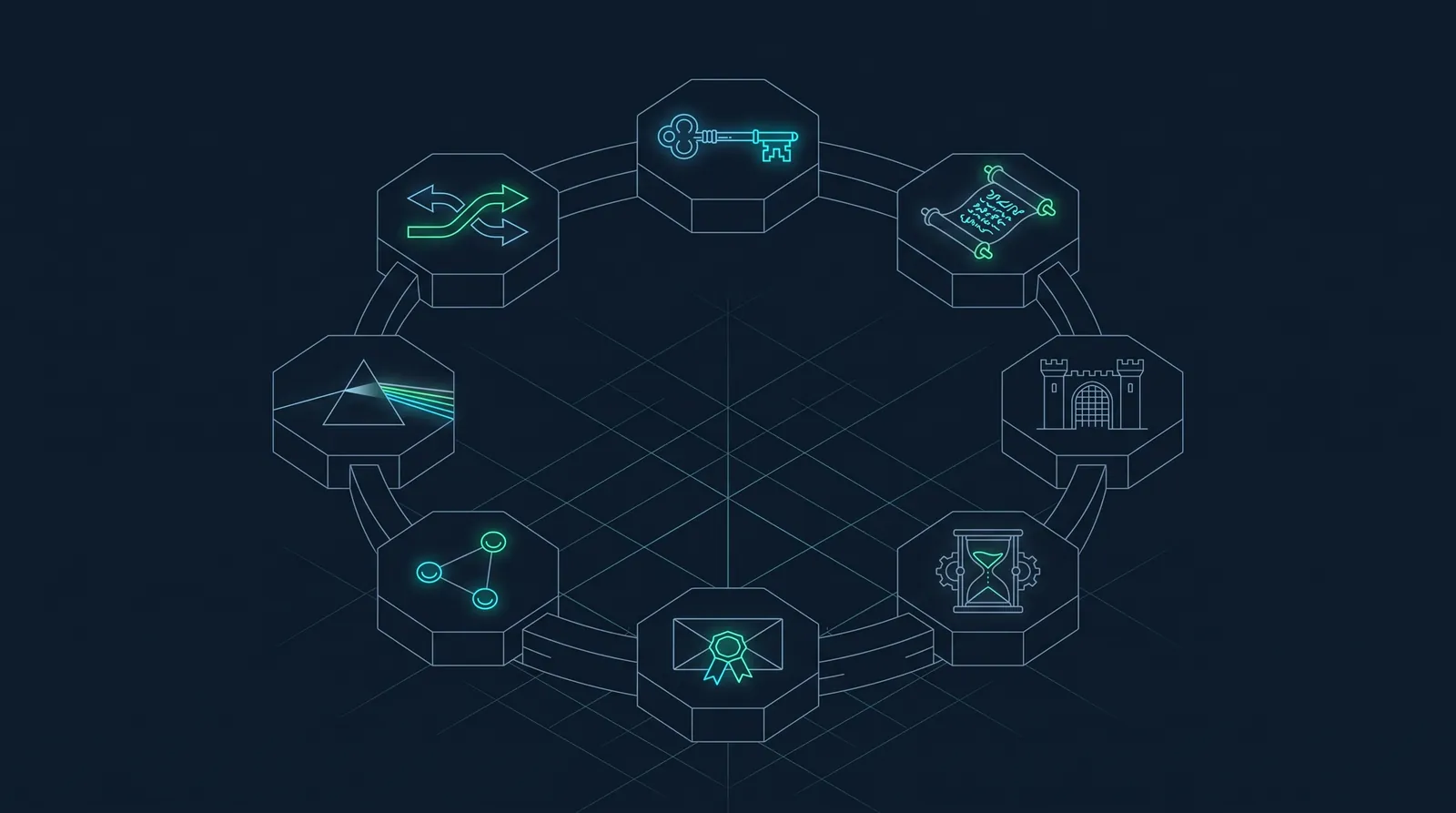
2. The Octagon: Eight Irreducible Axioms
Learning Objectives
- State and explain each of the eight zero-trust axioms
- Distinguish between axioms (invariants), corollaries (derived constraints), and implementation patterns (concrete realizations)
- Trace the refinement history of Axioms 3, 5, and 6 from their original formulations
- Map each axiom to the morphological dimensions it governs
Prerequisites: Chapter 1 (The Case for Zero-Trust)
Why Axioms?
An axiom is a statement accepted as true without proof, from which other statements are logically derived. In geometry, "two points determine a line" is an axiom — you do not prove it, you accept it as the foundation and build geometry on top. A zero-trust architecture needs the same kind of foundation: a set of core irreducible statements that, if satisfied, guarantee baseline zero-trust behavior. Additional specialized statements (Axioms 9-13) extend this foundation for emerging threats and organizational contexts.
The eight axioms presented here — the Octagon — were developed through a systematic first-principles analysis that stripped away every vendor name, every product feature, and every implementation pattern, asking only: "What must be true about any system that claims to distrust by default, verify continuously, and survive the compromise of its own components?"
The result is not a framework. It is a requirement specification. Any architecture that satisfies all eight core axioms is zero-trust. Any architecture that fails one is not. The rest of this book is about understanding what that means in practice.
Note: The eight Octagon axioms form the baseline requirement set for current deployments. Axioms 9–13 (Hendecagon and Tridecagon) extend this foundation for quantum-era and AI-speed threat modeling. See §2.4 (Beyond the Octagon) for the distinction between the current deployment mandate and the future research frontier.
The Axioms
Axiom 1: No Intrinsic Trust
No entity — user, workload, device, network path — possesses trust by virtue of its position, ownership, or prior relationship. Trust is a verdict rendered independently for each access decision, at the moment of access, based on the entity's current provable state.
This is the ontological core of zero-trust. In a traditional architecture, trust is a property: an IP address in the corporate subnet is trusted, an Active Directory account is trusted, a VPN connection is trusted. In zero-trust, trust is a transient verdict. It exists for the duration of one evaluation and evaporates the moment the next decision is required.
Corollary 1.1: A one-time successful verification does not imply future trust. Every access decision is independent.
Corollary 1.2: Trust is not transitive. Capabilities can be delegated — Service A can ask Service B to perform an action on its behalf — but the trust does not transfer. The PDP evaluates Service B's request independently, with full context of the delegation chain.
Corollary 1.3: The system must be capable of denying a request from an entity that was trusted one second ago, with no visible transition or re-authentication gate. The decay of trust is seamless.
Axiom 2: Explicit, Verifiable Policy
Every access decision evaluates against a machine-enforceable policy that is explicitly declared, non-contradictory, and independently verifiable by a neutral third party.
If Axiom 1 says "don't trust the entity," Axiom 2 says "don't trust the policy engine's word for what it decided." The policy must be a deterministic state machine: given the same inputs, the same outputs must result, every time, provably. An unauditable policy — a vendor black box, a hardcoded rule in a firewall nobody can replay — is indistinguishable from magic, and zero-trust has no room for magic.
Corollary 2.1: "Allow all" and "deny all" policies are degenerate. They collapse zero-trust into trust-everything or trust-nothing, both of which bypass the decision model entirely.
Corollary 2.2: The policy's evaluation history must be re-playable. Given a stored input, a neutral auditor must be able to execute the same policy and arrive at the same verdict. This is how you prove a denial was correct — or incorrect.
Corollary 2.3: Policy conflict must be detectable. Overlapping rules that produce ambiguous outcomes are a violation. The policy set must be consistent as a logical system.
Axiom 3: Unbypassable Mediation
There is no physical or logical path between any subject and any object that does not invoke the evaluation function.
The original formulation of this axiom was "Separation of Policy Decision from Enforcement" — the PDP and PEP must be distinct. This was rejected during peer review as an implementation pattern, not an invariant. Consider cryptographic data envelopes: if a payload is encrypted such that it only decrypts when CPU enclave state proves correct, the mathematics is both PDP and PEP. They are fused — and the architecture is still zero-trust because the mediation is unbypassable.
The true invariant is not who enforces but whether enforcement is escapable.
Corollary 3.1: Backdoors, administrative bypasses, and emergency override paths are mediation paths. They must invoke the same evaluation function as normal access, producing audited, non-repudiable decisions — even if the decision is always "allow" by design.
Corollary 3.2: The mediation boundary must be continuous. A network perimeter is not a mediation boundary if once inside it, entities communicate freely. Mediation extends to every interaction.
Corollary 3.3: Physical access is a mediation path. A console cable, a KVM switch, a hardware debug port — all must be mediated or the system is not zero-trust.
Axiom 4: Continuous Verification
Verdicts expire. Re-verification occurs at a cadence determined by risk, not by session convenience. The maximum acceptable interval between verifications is bounded by the fastest possible compromise-to-exploitation timeline in the defended adversary model.
A zero-trust system without this axiom is a traditional system with a very strong front door. The attacker who steals a valid session token can ride it for hours because verification happened once and was never revisited. Axiom 4 makes time a first-class dimension of the security model.
Corollary 4.1: The re-verification interval is an explicit, configurable parameter driven by threat model, not by session management convenience. Defense against an AI Kiddie may tolerate 15-minute intervals. Defense against an APT may require sub-second.
Corollary 4.2: "Continuous" does not mean "constant." It means the re-verification cadence is risk-calibrated and the system can produce a fresh verdict before an action is completed. The interval is a design parameter, not an aspiration.
Corollary 4.3: Re-verification must be invisible to the legitimate entity. If every API call triggers a step-up auth challenge, the system is unusable. Behavioral signals, hardware attestation, and JIT credential minting enable continuous verification without continuous interruption.
Axiom 5: Deterministic Bounded Authority
Every grant of access confers a mathematically bounded vector of permitted state transitions. The blast radius of any single credential compromise is explicitly calculable prior to authorization. Authority cannot expand without a new, independent authorization decision.
The original formulation — "Least Privilege with Minimal Blast Radius" — included a corollary that authority should be restricted to a single resource-action pair. This was rejected as mathematically impossible without infinite overhead. The refinement: the blast radius must be explicitly bounded and calculable, not necessarily atomic. "Admin" is an anti-pattern not because it is broad but because it is unbounded — nobody can calculate what an admin credential can do because the scope is "whatever the system allows."
Corollary 5.1: Role-based access control (RBAC) without explicit scope bounding is insufficient. "DevOps," "Engineer," "Admin" are labels, not authority vectors.
Corollary 5.2: Authority is a mathematically complete set of permitted state transitions. If an action is not explicitly in the set, it is denied.
Corollary 5.3: A credential that grants access to "all resources in namespace X" violates this axiom unless the contents of namespace X are themselves bounded and immutable at authorization time.
Axiom 6: Byzantine Fault Tolerance
The architecture maintains structural and epistemic integrity even when N of its components act maliciously or arbitrarily. Compromise of a single component does not compromise the system.
The original formulation was "Assume Breach with Auditability" — a mindset, not an invariant. The true systemic requirement is that the system survives the malice of its own parts. A compromised PEP cannot alter policy. A compromised log agent cannot erase history. A compromised user session cannot cascade into a network-wide lockdown.
Corollary 6.1: Every access decision must produce a non-repudiable, timestamped, integrity-protected audit record that outlives the compromise of the system that produced it.
Corollary 6.2: A defensive action — a Hard Deny, a session revocation, a node quarantine — must not itself become a Byzantine fault. Locking out legitimate users in response to an attack is the system harming itself on behalf of the attacker.
Corollary 6.3: The system must detect divergence between independent observers and surface it as a security event. If one observer says "normal" and another says "anomalous," the system does not choose — it escalates.
Axiom 7: Epistemic Integrity — Provenance of State
State inputs to the evaluation function must carry cryptographic proof of provenance. Unattested data is treated as hostile input and may be used only to deny access, never to grant it.
This axiom was missing from the original formulation and was added during peer review — and it proved to be the single most universally violated invariant across all real-world architectures. Without epistemic integrity, all other axioms collapse. A perfectly deterministic policy (Axiom 2) evaluated on fabricated telemetry produces a perfectly wrong verdict. An unbypassable mediator (Axiom 3) that trusts a self-reported device posture from a compromised OS is enforcing on lies.
Corollary 7.1: Self-reported state from an unverified source cannot be used to grant access. A device claiming "I am patched" without a TPM-signed attestation report is hostile input.
Corollary 7.2: The provenance chain must be end-to-end verifiable. From the silicon root through the firmware, kernel, runtime, and application — each layer attests to the integrity of the layer above it.
Corollary 7.3: Behavioral provenance — "this user's typing pattern matches their baseline" — is signal, not proof. Behavioral signals may trigger denial when violated but cannot independently authorize access without cryptographic provenance alongside them.
Axiom 8: Bilateral Symmetry — Mutual Verification
Trust evaluation is inherently bidirectional. The requesting entity must prove its state to the resource, and the resource must prove its state to the requesting entity, prior to any data exchange.
Zero-trust is traditionally presented as protecting resources from untrusted requesters. But the inverse is equally critical: the requester must verify the resource before sending sensitive data. A client that sends protected health information to a server it has not verified is trusting the server intrinsically — violating Axiom 1. A microservice that forwards a payment token to an upstream it has not attested is gambling.
Corollary 8.1: Mutual TLS (mTLS) satisfies the minimum form of bilateral symmetry at the transport layer. But transport verification is insufficient — both parties must verify application-layer identity, policy compliance, and runtime integrity state.
Corollary 8.2: A verified client sending data to an unverified server is a breach of architecture. The infrastructure holds no intrinsic trust over the client.
Corollary 8.3: Bilateral verification enables data sovereignty — the client can refuse to transmit sensitive data to a resource that fails its verification, even if the resource's policy engine would have allowed the request.
Refinement History
The Octagon did not emerge fully formed. It was refined through peer review against four distinct deployment archetypes and stress-tested against future quantum and AI adversaries. The change log:
| Axiom | Original Formulation | Issue Identified | Refinement |
|---|---|---|---|
| 3 | Separation of PDP from PEP | Implementation pattern, not invariant. Cryptographic data envelopes fuse PDP and PEP. | Replaced with Unbypassable Mediation |
| 5 | Least Privilege with Minimal Blast Radius | "Single resource-action pair" is computationally impossible. | Refined to Deterministic Bounded Authority |
| 6 | Assume Breach with Auditability | A mindset, not a systemic invariant. | Refined to Byzantine Fault Tolerance |
| 7 | (missing) | Without provenance of state, all other axioms collapse on fake inputs. | Added: Epistemic Integrity |
| 8 | (missing) | Unilateral enforcement ignores the client's right to verify the resource. | Added: Bilateral Symmetry |
Mapping Axioms to Morphological Dimensions
The eight axioms do not map one-to-one to architectural dimensions. Each axiom typically governs two or more dimensions, and the interactions are where architecture problems surface. This table is the bridge between Part I (theory) and Part II (architecture):
| Axiom | Primary Dimension(s) | Secondary Dimension(s) |
|---|---|---|
| 1. No Intrinsic Trust | D2 (Identity Model) | D5 (Violation Response) |
| 2. Verifiable Policy | D7 (Observability Trust) | D6 (Policy Distribution) |
| 3. Unbypassable Mediation | D3 (Enforcement Layer) | D6 (Policy Distribution) |
| 4. Continuous Verification | D4 (Attestation Modality) | D2 (Identity: Trust Decay — Continuous Auth) |
| 5. Bounded Authority | D2 (Identity: Zero Standing Privileges) | D3 (Enforcement: Data — Cryptographic) |
| 6. Byzantine Fault Tolerance | D5 (Violation Response) | D4 (Attestation), D7 (Observability) |
| 7. Epistemic Integrity | D1 (Trust Anchor) | D4 (Attestation), D7 (Observability) |
| 8. Bilateral Symmetry | D3 (Enforcement: Bilateral — Mutual Enforcement) | D6 (Policy: Bilateral/Consensus) |
Pattern: Axiom 7 (Epistemic Integrity) is the most dimensionally expensive — it requires D1 (Silicon Root of Trust), D4 (Heterogeneous Triple↗), and D7 (Merkle-Attested Telemetry↗) all to reach a meaningful level. This explains the finding, explored in Chapter 12, that Epistemic Integrity is the single most universally violated axiom across real-world deployments.
Beyond the Octagon: Hendecagon and Tridecagon
The Octagon's eight axioms are the stable, peer-reviewed foundation — individually necessary and collectively sufficient for any architecture to be zero-trust. But the refinement process that produced Axioms 7 and 8 did not stop at eight. Adversarial stress-testing against quantum computing threats and AI-speed adversaries revealed additional invariants that an architecture must satisfy to survive the next decade of threat evolution. These are not yet formalized with corollaries — they are forward-looking extensions, acknowledged here and explored fully in §18: Decision Matrix, Forward-Looking Axioms, and Conclusion.
Axiom 9 — Functional Preservation
The system must continue to perform its operational function even while under active attack, without degrading to denial-first responses. Business continuity and security are not a tradeoff — an architecture that preserves confidentiality by destroying availability has handed the attacker a denial-of-service victory.
Axiom 10 — Sovereign Quorum
No single organization may unilaterally declare an entity trusted. Trust verdicts that cross organizational boundaries require cryptographic attestation from a quorum of independent — and jurisdictionally decorrelated — verifiers, preventing any one compromised or compelled authority from contaminating the trust fabric.
Axiom 11 — Temporal Epistemic Integrity
The trustworthiness of state evidence degrades with time. Provenance proofs have a shelf life determined by the cryptographic algorithms that secure them. An architecture that does not account for algorithmic obsolescence is building on a foundation with a known expiration date.
Axiom 12 — Algorithmic Impermanence
No cryptographic algorithm is permanent. The architecture must support algorithm migration as a continuous operation — not a one-time transition with a flag day. NIST's post-quantum cryptography migration timeline (RSA/ECC deprecation by 2030, disallowance by 2035) makes this an operational requirement within the architecture's design lifetime.
Axiom 13 — Architectural Polymorphism
The system's structural and behavioral patterns must be non-static, presenting a continuously varying attack surface to adversaries operating at machine speed. An architecture whose topology, routing, and response behavior are predictable is an architecture that an AI-speed adversary can model faster than a human can defend.
These five extensions form two progressive classifications: the Hendecagon (Axioms 1–11) adds Functional Preservation, Sovereign Quorum, and Temporal Epistemic Integrity to the Octagon's core — eleven axioms together. The Tridecagon (Axioms 1–13) adds Algorithmic Impermanence and Architectural Polymorphism — the full thirteen. The Octagon is the deployment mandate: what you must satisfy today. The Hendecagon and Tridecagon are the research frontier: what you must prepare for tomorrow.
Key Takeaways
- The Octagon defines eight axioms that are individually necessary and collectively sufficient for zero-trust architecture. Any system that fails one is not zero-trust.
- Axioms are not implementation patterns. Axiom 3 was originally "separate PDP from PEP" and was replaced with "unbypassable mediation" because cryptographic enforcement fuses the roles while still satisfying the invariant.
- Axiom 7 (Epistemic Integrity) and Axiom 8 (Bilateral Symmetry) were missing from the initial formulation and were added during peer review. They are now the most universally violated axioms in practice.
- Every axiom governs multiple morphological dimensions. The axiom-dimension mapping table is the structural bridge between Part I (theory) and Part II (architecture).
Cross-References
Next: §3: The Octagon as Validation InstrumentBuilds On: §1: The Case for Zero-Trust